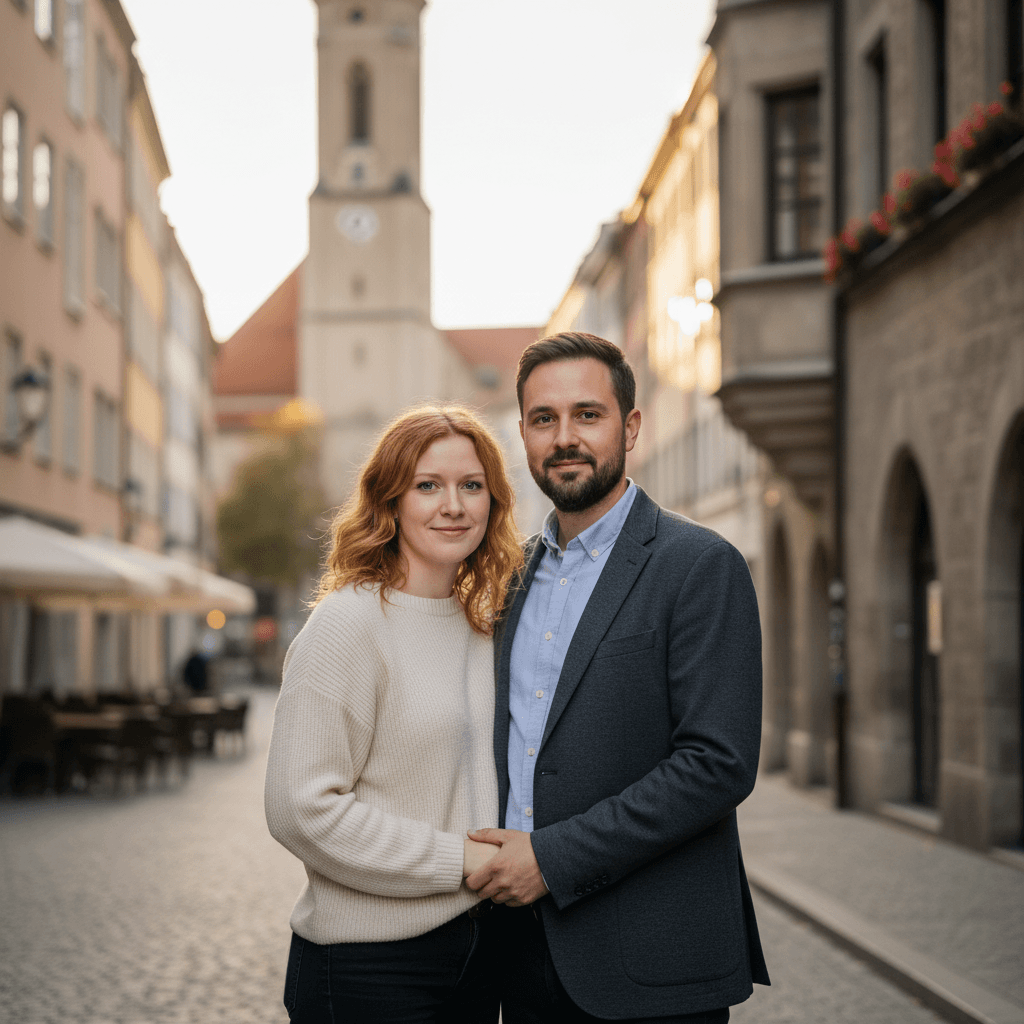
Lisa & Marc(36)
Amsterdam → München
Marc and I met in 2014 at a party in Amsterdam. He was a Münchener, working as a consultant at McKinsey. I was a project manager at Booking.com. We lived together in Amsterdam for ten years, but when I got pregnant, everything changed. Marc's parents lived in Munich, mine in Hilversum. We wanted help from grandparents, and Marc wanted to return to his Heimat. Munich became our compromise — with grandparents around the corner.
The Elterngeld was the financial reason to have and raise our baby in Germany. Germany pays 65-67% of your net salary for 12 months to the parent who stays home. With ElterngeldPlus you can spread it over 24 months. I received €1,800 per month in Elterngeld — in the Netherlands I would have only had 16 weeks of maternity leave and then had to return or take unpaid leave. The difference is enormous.
As the spouse of a German, the Anmeldung and residence were simple — as an EU citizen you have the right to live and work in Germany anyway. Marc handled most paperwork because he knows the system. We chose Steuerklasse III for Marc (the main earner) and Steuerklasse V for me — a combination that maximizes net income when one partner earns significantly more. After my return to work we switched to Steuerklasse IV/IV with Faktor.
The Krankenkasse was a deliberate choice. Marc as a consultant earned above the Versicherungspflichtgrenze (€69,300 in 2024) and was privately insured with Debeka. I joined the gesetzliche Krankenversicherung through my employer at TK. In Germany married couples can be in different systems — strange but legal. Our child is co-insured with Marc in the PKV, because the privately insured parent earns more. The Familienversicherung in the GKV would have been cheaper, but that's not allowed when the PKV parent earns more.
The Munich Kita situation is notorious. We registered our daughter on the waiting list during pregnancy — through the kita finder+ portal of the city of Munich. Despite the early registration it took nine months to get a spot in a Kinderkrippe. Costs are income-based: we pay €390 per month for five days. The Kita closes at 17:00 — earlier than Dutch childcare — which makes planning with two working parents complex.
Munich with a young family is wonderful despite the costs. The Englischer Garten is our backyard, the Isar is our playground, and the Biergärten are surprisingly child-friendly. The Kindergeld of €250 per month helps, and the combination of Elterngeld, Kita and the proximity of Marc's parents makes raising children here more comfortable than in Amsterdam. My tip for mixed couples: leverage the advantages of both systems. Marc keeps his Deutsche Rentenversicherung, I keep my Dutch pension rights through the treaty. The best of both worlds.
Highlights
- Elterngeld: 65-67% of net salary for 12 months
- Steuerklasse III/V combination maximizes net income
- Kita registration in Munich: sign up during pregnancy
- Mixed couples: combine pension rights from both countries
Other stories

Marco
Venlo → Düsseldorf
As a nurse I had been commuting across the border for years. When I decided to actually move to Düsseldorf, the real paperwork began.

Niels
Amsterdam → Berlijn
Amsterdam rent prices drove me away. Berlin offered a startup job, an affordable apartment and a vibrant nightlife.
Dennis & Laura
Arnhem → Kleve
With three children we moved from Arnhem to Kleve. A bigger house, Kindergeld and a Grundschule around the corner — but the German school system took some getting used to.