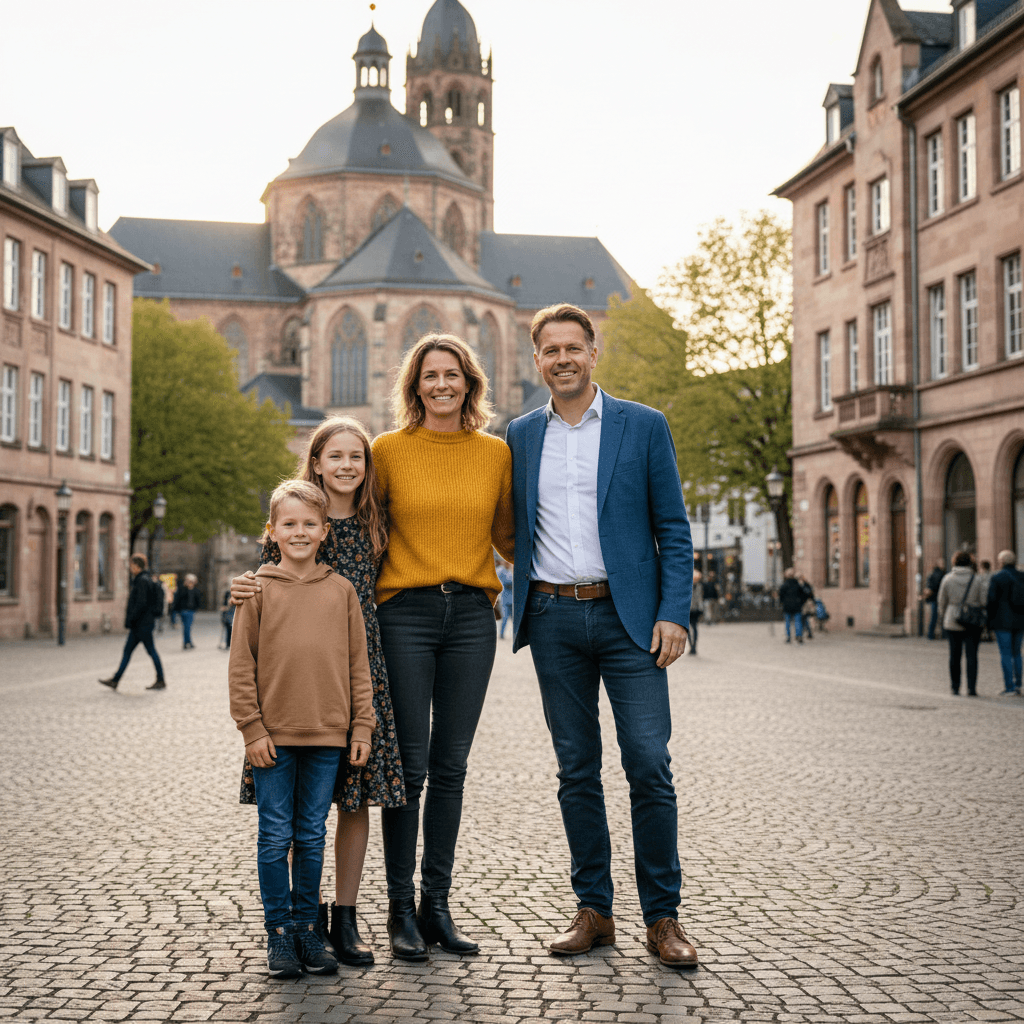
Jeroen & Katja(41)
Nijmegen → Aken
Katja and I lived in Nijmegen for twelve years. We loved the city, but house prices had gone through the roof. A terraced house in Nijmegen-Oost cost €500,000. Katja's sister already lived in Aachen and told us about the affordable houses just across the border. We went to look and were amazed: for €310,000 we bought a Reihenhaus with garden in Aachen-Brand, a 35-minute drive from my work in Nijmegen.
The Grenzgänger existence is financially complex. I work in the Netherlands but live in Germany. Based on the tax treaty I pay income tax in the Netherlands, but must also file a return in Germany. The Einkommensteuererklärung in Germany is needed to determine if I owe additional tax. In practice I pay slightly more tax than if I lived in just one country, but the difference is more than compensated by lower house prices.
The Krankenkasse was the most confusing part. As a Grenzgänger working in the Netherlands, I'm insured through the Dutch system. But because I live in Germany, I'm entitled to care in both countries. I requested an S1 form from my Dutch health insurer, which allows me to register with a German Krankenkasse for local care. Katja, who doesn't work, is co-insured. It sounds complicated — and it is.
For the children the move was an adventure. Our eight-year-old daughter went to the Grundschule in Brand. The first six months were tough — she didn't speak German — but the school was prepared for multilingual children. The Offene Ganztagsschule (OGS) offered after-school care until 16:00, including homework support and a warm meal. In the Netherlands we paid €800 per month for after-school care; in Germany the OGS costs €80 per month.
Aachen has a special position as a border city. The Dreiländereck — the three-country point with Belgium and the Netherlands — is around the corner. In the supermarket you hear German, Dutch and French. RWTH Aachen, one of the best technical universities in Europe, attracts international students and companies. The city is smaller than Nijmegen but feels more cosmopolitan. And the Aachener Printen — the local Christmas pastry — are addictive.
My advice to Grenzgänger: get a Steuerberater who knows both systems. I pay €500 per year for an advisor who handles both my Dutch and German tax returns. Without him I'd drown in paperwork. Also: register with a Grenzgänger information center like the GrenzInfoPunkt. They offer free advice on taxes, insurance and pensions for people who work and live across borders.
Highlights
- Grenzgänger: S1 form for healthcare in both countries
- Reihenhaus in Aachen: €310,000 vs. €500,000 in Nijmegen
- OGS after-school care: €80/month vs. €800 in Netherlands
- GrenzInfoPunkt offers free advice for cross-border workers
Other stories

Marco
Venlo → Düsseldorf
As a nurse I had been commuting across the border for years. When I decided to actually move to Düsseldorf, the real paperwork began.

Niels
Amsterdam → Berlijn
Amsterdam rent prices drove me away. Berlin offered a startup job, an affordable apartment and a vibrant nightlife.
Dennis & Laura
Arnhem → Kleve
With three children we moved from Arnhem to Kleve. A bigger house, Kindergeld and a Grundschule around the corner — but the German school system took some getting used to.